
Want real case studies? 10 seconds to sign up
Join the platform
June 23, 2025
Approximately 5 minutes
Reviewed by Nate Lam, Founder & Director, ElendiLabs
The Role of Summary Technical Documentation (STED) in Hong Kong MDACS: – Our Perspective
In Hong Kong's Medical Device Administrative Control System (MDACS), showing that your medical device is safe and performs as it should is a core requirement for getting it listed. To our understanding, one of the main ways manufacturers and Local Responsible Persons (LRPs) prove this is through the Summary Technical Documentation (STED). Technical Reference TR-002, titled "Summary Technical Documentation for Demonstrating Conformity to the Essential Principles of Safety and Performance of Medical Devices," gives very detailed guidance on exactly what should be in this crucial document and how it should be organized. This is vital for medical device documentation Hong Kong.
What's the Big Idea Behind STED? Its Purpose Explained
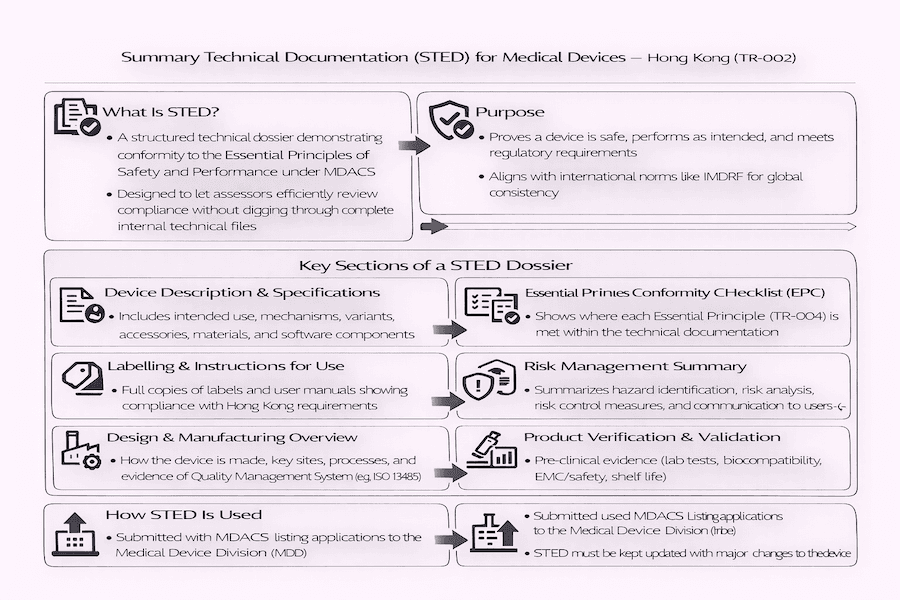
So, why do we need STED? Think of the STED as a well-organized, comprehensive collection of information. Its job is to objectively show that a medical device truly meets the Essential Principles of Safety and Performance (which are detailed in TR-004). From our perspective, it allows the Medical Device Division (MDD) to quickly and efficiently check if a device complies, without needing to dig through a massive, in-depth technical file right away. But don't get us wrong, it still provides enough detail for a thorough review. What makes a STED more extensive? The amount of evidence needed in the STED definitely grows with the medical device's risk class, how complex it is, and if it uses new technology. This directly impacts medical device registration Hong Kong.
Key Sections of a STED Dossier: What Goes Inside?
TR-002 clearly outlines the mandatory sections that a STED dossier must contain to properly show that your device conforms to the rules. Based on our experience, these sections typically include:
- Device Description and Specification (Including Variants and Accessories): What is Your Device?
- You need a clear, brief description of your device, what it's for (its intended purpose), what conditions it's used to treat or diagnose, and how it actually works.
- Information about different versions (variants) of your device, any accessories, and how they relate to the main device.
- Details about the materials you've used, how it operates, and any software parts.
- Labelling and Instructions for Use (IFU): How Will People Use It Safely?
- Copies of all your labelling, including packaging labels, markings on the device itself, and the full Instructions for Use (IFU).
- Crucially, it must be clear that you meet Hong Kong's specific labelling requirements (like TR-005, which talks about needing both English and Chinese content, the HKMD No., and LRP information). This helps ensure medical device compliance Hong Kong.
- Design and Manufacturing Information: How Was It Made?
- A general overview of how you manufacture the device.
- Details about important manufacturing sites and processes.
- Proof that you have a strong Quality Management System (QMS) in place, usually shown by an ISO 13485 certification or something similar.
- Essential Principles Checklist (EPC): Ticking All the Boxes
- This is a checklist that identifies all the Essential Principles that apply to your specific device.
- For each principle, your STED should point to the exact sections in your technical documentation where you've shown conformity. According to our experience, this acts like a clear roadmap for the MDD assessor, making their job much easier.
- Risk Management: Identifying and Controlling Dangers
- A summary of your plan for managing risks and the results of your risk analysis (for example, following ISO 14971 standards).
- Evidence that you've found all the risks, evaluated them, and reduced them as much as reasonably possible.
- Information about any risks that couldn't be completely eliminated and how you tell users about them.
- Product Verification and Validation: Proving It Works
- Pre-clinical Data: Summaries of lab tests, studies on how it interacts with biological materials (biocompatibility), electrical safety, electromagnetic compatibility (EMC), software checks, sterilization checks, and shelf-life studies.
- Clinical Data: Summaries of how the device performed in actual clinical settings, any clinical investigations or trials you've done (if applicable), and data from monitoring it after it's been sold. To our understanding, the type and amount of clinical evidence you need depend heavily on how risky and new your device is.
- Performance Evaluation (for IVDMDs only): Specific data showing how well In Vitro Diagnostic medical devices perform analytically and clinically.
Preparing the STED Dossier: Our Practical Advice
Manufacturers, usually working hand-in-hand with their LRP, are responsible for putting together the STED dossier. What are some key things we always tell our clients to keep in mind during this preparation?
- Clarity and Conciseness: While it needs to be comprehensive, the STED should be well-organized and easy for someone to read and understand quickly.
- Traceability: Make sure there are clear connections between each Essential Principle and the specific technical documents that support it.
- Accuracy: All the information you provide must be precise and reflect the current status of your device.
- Language: The documentation should be in English, and for some parts, it might also need to be in Chinese, as specified by MDACS guidelines. According to our experience, the STED isn't a one-and-done document; it's a living one. Any significant changes to your device (as explained in GN-10) will require you to update your STED dossier to keep your device's listing valid. Successfully submitting a well-prepared STED is a crucial step towards getting your medical devices into the Hong Kong market.
Need Regulatory Help? Try Our Platform
Post your regulatory questions or request quotations from verified pharmaceutical consultants worldwide. Get matched with experts who specialize in your market.
Unbeatable Pricing
Transparent, competitive rates for medical device registration in Hong Kong.

Registered Pharmacist · AI Engineer · Director, ElendiLabs
Registered pharmacist, AI engineer, HKHAIS founder, and pharmaceutical & medical device SEO/GEO specialist.
Ask Anything
We'll follow up with you personally.
100% response rate • Reply within 7 business days
Related Articles
Approximately 5 minutes
Medical Device Adverse Event Reporting in Hong Kong: A Guide for LRPs
Adverse event reporting is a critical component of Hong Kong's Medical Device Administrative Control System (MDACS), aiming to enhance public health and safety. This article outlines the requirements and responsibilities of Local Responsible Persons (LRPs) in reporting adverse events related to listed medical devices, based on our insights.
Approximately 5 minutes
Hong Kong Medical Device Regulations: MDACS Guide
A practical guide to Hong Kong medical device regulations, MDACS classification, listing requirements, local responsibility, and post-market duties.
Approximately 5 minutes
Hong Kong MDACS Medical Device Regulations: Framework and Compliance
Understand Hong Kong MDACS medical device regulations, the Department of Health framework, classification, listing, and post-market control for market access.
Approximately 5 minutes
Listing Procedures for Local Medical Device Manufacturers in Hong Kong: A Guide to GN-08
This article details the application process for local medical device manufacturers seeking to be listed under Hong Kong's Medical Device Administrative Control System (MDACS), as guided by GN-08. It covers eligibility, quality management system requirements, and the submission process, all based on our insights and experience for effective Hong Kong medical device manufacturing.
Approximately 5 minutes
Listing Procedures for Medical Device Importers in Hong Kong: A Guide to GN-07
For entities importing medical devices into Hong Kong, the Medical Device Administrative Control System (MDACS) provides a voluntary listing scheme for importers, guided by GN-07. This article details the eligibility, application steps, and key requirements for listing as a medical device importer, based on our insights and experience for efficient Hong Kong medical device import.
Approximately 5 minutes
Hong Kong Medical Device Distributor Listing (GN-09)
How medical device distributors list under Hong Kong MDACS per GN-09: eligibility, documented procedures, MDIS submission, and ongoing compliance.
Approximately 5 minutes
Hong Kong IVD Registration: MDACS Listing for Class B–D IVDMDs
Learn Hong Kong IVD registration and MDACS listing procedures for Class B, C, and D in vitro diagnostic medical devices, including dossier and LRP requirements.