
Want real case studies? 10 seconds to sign up
Join the platform
June 23, 2025 · Updated May 7, 2026
Approximately 5 minutes
Reviewed by Nate Lam, Founder & Director, ElendiLabs
Quick answer
Hong Kong classifies general medical devices under MDACS Technical Reference TR-003 using a risk-based framework. The device class depends on factors such as invasiveness, duration of use, active function, contact with the body, and whether the device supports or sustains life. Classification drives the evidence and listing pathway for Hong Kong market access.
General Medical Device Classification in Hong Kong: Regulatory Standards and MDACS Requirements
The Medical Device Administrative Control System (MDACS) in Hong Kong utilizes a risk-based classification framework to ensure that regulatory oversight is commensurate with the potential risks associated with a medical device. For general medical devices, the governing principles and specific rules for categorization are established in Technical Reference TR-003, titled "Classification of General Medical Devices." Compliance with this document is mandatory for manufacturers and Local Responsible Persons (LRPs), as the assigned risk class dictates the necessary conformity assessment procedures and the overall requirements for the MDACS listing process.
The classification principles detailed in TR-003 align with international harmonized standards, specifically those developed by the International Medical Device Regulators Forum (IMDRF), ensuring that Hong Kong’s regulatory environment remains consistent with global best practices.
The Four Risk Classes: Hierarchy of Regulatory Scrutiny
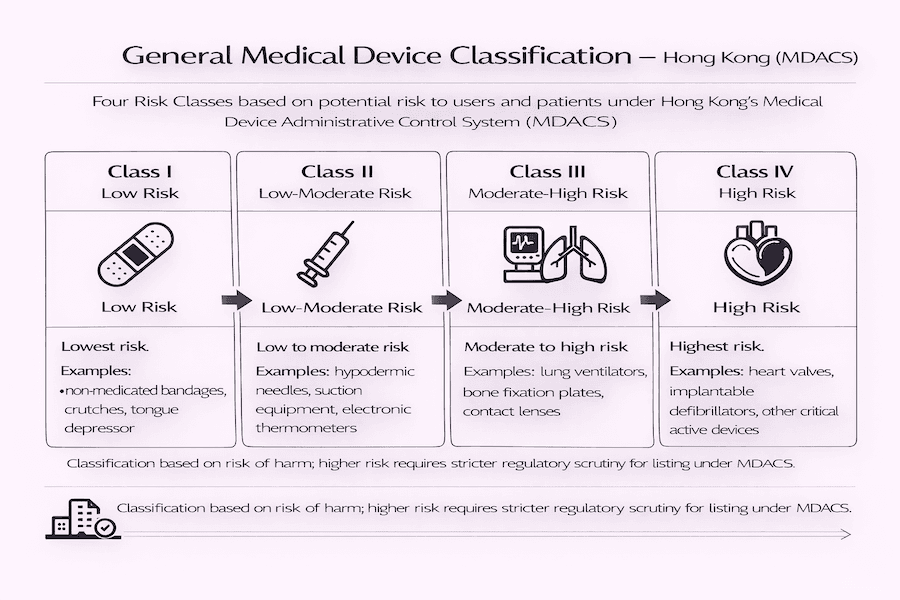
General medical devices under the MDACS framework are categorized into four distinct classes based on their risk profile. As the risk level increases, the degree of regulatory scrutiny and the requirements for clinical and technical evidence become more stringent.
- Class I (低風險): Lowest risk devices, such as non-medicated bandages, crutches, or tongue depressors. These devices generally do not require listing under MDACS.
- Class II (中低風險): Low-to-moderate risk devices, including hypodermic needles, suction equipment, and electronic thermometers.
- Class III (中高風險): Moderate-to-high risk devices, such as lung ventilators, bone fixation plates, and contact lenses.
- Class IV (高風險): Highest risk devices, comprising critical items such as heart valves, implantable defibrillators, and other active implantable devices.
The classification of a device directly determines the complexity of the listing application and the depth of the safety and performance data required by the Medical Device Division (MDD).
Principles of Classification: Determining the Regulatory Category
TR-003 outlines specific criteria used to determine a device’s classification. This categorization is based on the manufacturer’s defined intended use and the technical design of the product. The following factors, individually or in combination, dictate the risk class:
- Duration of Contact: The length of time the device remains in contact with the body (transient, short-term, or long-term).
- Degree of Invasiveness: Whether the device is non-invasive, invasive (via a body orifice or surgical entry), or implantable.
- Delivery of Medicinal Products or Energy: The method and nature of energy or medication delivery to the patient.
- Biological or Systemic Effects: Whether the device is intended to have a biological effect or be absorbed by the body.
- Combination Use: The classification may be influenced by whether the device is designed to be used in conjunction with another medical device.
- Standalone Software: Software that meets the definition of a medical device is classified based on its intended use and associated risks, typically categorized as an active device.
Application of Classification Rules: Regulatory Methodology
Manufacturers must follow a systematic approach when applying the classification rules defined in TR-003:
- Systematic Evaluation: Each device must be assessed against every applicable rule in the Technical Reference.
- The Highest Class Principle: In instances where multiple classification rules apply to a single device, the rule that results in the highest risk classification must be adopted. This conservative approach prioritizes patient safety by ensuring the device meets the most rigorous standards applicable.
- Design-Specific Analysis: While TR-003 provides illustrative examples, final classification must be based on the specific technical characteristics, indications for use, and clinical application of the individual device rather than general analogies.
Manufacturer Responsibilities and the Role of the LRP
The manufacturer holds the primary responsibility for the accurate classification of a medical device according to TR-003. A detailed regulatory rationale supporting the assigned risk class should be documented and maintained, as this serves as a critical component of the MDACS review process.
The Local Responsible Person (LRP) acts as the essential intermediary for foreign manufacturers in Hong Kong. The LRP ensures that the listing application correctly reflects the device's risk class and aligns with local regulatory expectations. Correct classification is the foundational step of the registration process; misclassification frequently results in significant approval delays, requests for additional information, or regulatory non-compliance.
Adherence to the principles of TR-003 ensures that medical devices on the Hong Kong market are subject to appropriate oversight, thereby safeguarding public health and ensuring the safety and performance of medical technologies.
Need Regulatory Help? Try Our Platform
Post your regulatory questions or request quotations from verified pharmaceutical consultants worldwide. Get matched with experts who specialize in your market.
Unbeatable Pricing
Transparent, competitive rates for medical device registration in Hong Kong.

Registered Pharmacist · AI Engineer · Director, ElendiLabs
Registered pharmacist, AI engineer, HKHAIS founder, and pharmaceutical & medical device SEO/GEO specialist.
Ask Anything
We'll follow up with you personally.
100% response rate • Reply within 7 business days
Related Articles
Approximately 5 minutes
Medical Device Adverse Event Reporting in Hong Kong: A Guide for LRPs
Adverse event reporting is a critical component of Hong Kong's Medical Device Administrative Control System (MDACS), aiming to enhance public health and safety. This article outlines the requirements and responsibilities of Local Responsible Persons (LRPs) in reporting adverse events related to listed medical devices, based on our insights.
Approximately 5 minutes
Hong Kong Medical Device Regulations: MDACS Guide
A practical guide to Hong Kong medical device regulations, MDACS classification, listing requirements, local responsibility, and post-market duties.
Approximately 5 minutes
Hong Kong MDACS Medical Device Regulations: Framework and Compliance
Understand Hong Kong MDACS medical device regulations, the Department of Health framework, classification, listing, and post-market control for market access.
Approximately 5 minutes
Listing Procedures for Local Medical Device Manufacturers in Hong Kong: A Guide to GN-08
This article details the application process for local medical device manufacturers seeking to be listed under Hong Kong's Medical Device Administrative Control System (MDACS), as guided by GN-08. It covers eligibility, quality management system requirements, and the submission process, all based on our insights and experience for effective Hong Kong medical device manufacturing.
Approximately 5 minutes
Listing Procedures for Medical Device Importers in Hong Kong: A Guide to GN-07
For entities importing medical devices into Hong Kong, the Medical Device Administrative Control System (MDACS) provides a voluntary listing scheme for importers, guided by GN-07. This article details the eligibility, application steps, and key requirements for listing as a medical device importer, based on our insights and experience for efficient Hong Kong medical device import.
Approximately 5 minutes
Hong Kong Medical Device Distributor Listing (GN-09)
How medical device distributors list under Hong Kong MDACS per GN-09: eligibility, documented procedures, MDIS submission, and ongoing compliance.
Approximately 5 minutes
Hong Kong IVD Registration: MDACS Listing for Class B–D IVDMDs
Learn Hong Kong IVD registration and MDACS listing procedures for Class B, C, and D in vitro diagnostic medical devices, including dossier and LRP requirements.